
How a Monroe County Property Search Works
The West Virginia State Auditor's Real Property Search is the public starting form for Monroe County. It accepts many kinds of clues. Address, owner, parcel, book/page, tax year, and jurisdiction all work as search terms. A parcel number is the sharpest key once you hold it. An address is easier to recall. An owner name can surface several accounts. Treat every result as a lead. The portal posts no start year for its property records. The tax roll is an administrative record, not a title decision. A deed may name several grantors or grantees. A spouse, trustee, or fiduciary may appear there too, so read the land description and the prior book/page references, especially where land was split or merged.
- Choose Parcel ID if known. Otherwise enter the street number, street, ZIP, or one owner-name field and check all plausible results.
- Record the tax year and jurisdiction with the parcel ID; do not infer jurisdiction from the postal city.
- Carry the owner and book/page clue to the Monroe County Clerk to locate the deed and prior instrument.
- Check the Sheriff’s Tax Office for bill or payment detail, and ask county mapping staff for a parcel or floodplain map.
- Request an ordinary or certified copy from the custodian if an official document is needed.
Monroe County IAS Search Fields
The IAS real-property screen is the county's main interface for a Monroe County property search. Its visible labels are worth learning first. Parcel State Class, jurisdiction, sort order, and page size all appear as controls on the form. The dropdown choices behind them are not documented. Partial-match behavior is likewise unstated, so start with fewer characters if a search comes back empty. Then confirm the parcel with the assessor.
| Visible field | Control | Required | What the research confirms |
|---|---|---|---|
| Parcel ID | Text | No | Exact parcel key; public format not posted |
| Parcel State Class | Dropdown | No | Options not exposed |
| Parcel Address # / Street | Text | No | Address fields; partial-match rules not posted |
| Zip Code | Text | No | Postal filter, not a town boundary |
| Owner Name 1 / Owner Name 2 | Text | No | Two name inputs are visible |
| Book / Page | Text | No | Recording reference fields |
| Tax Year | Dropdown | Yes | Available years were not exposed |
| Jurisdiction | Dropdown | No | Taxing jurisdiction control |
| Sort / Results per page | Select or input | No | Option list not captured |
Open the official IAS real-property search to use the live form. The official page shows the search screen itself, not a parcel example.
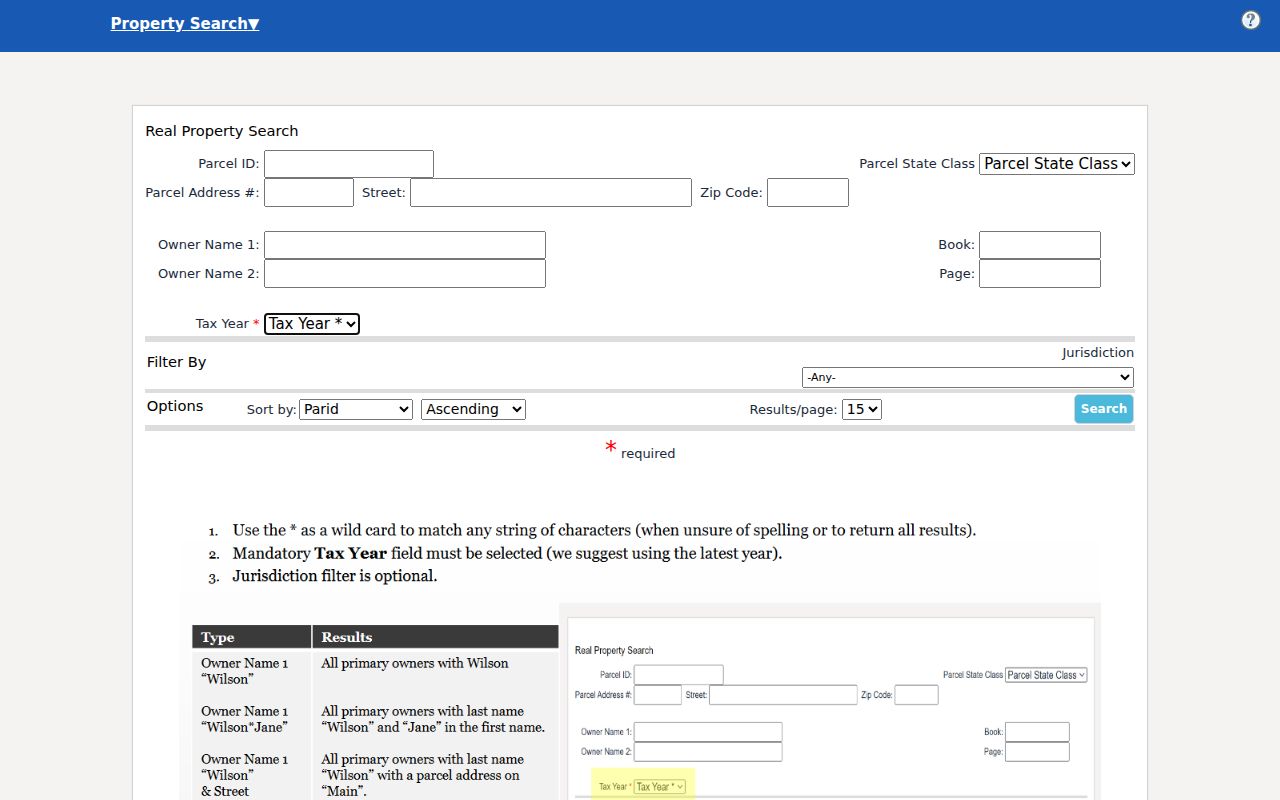
The state portal publishes no sample owner card or assessment history online. Deed results come from the county's own deed records instead.
What a Monroe County Property Record Shows
The search form itself is easy to reach. What the result card displays is another matter. Its field names and image controls stay behind the search itself. Treat the table as a checklist for the Assessor. Do not assume what shows on screen. Ask the office which values it provides for a chosen tax year. The list should include exemptions and legal description lines. The same request should cover the sale reference and any prior parcel links.
| Owner name | Owner Name 1 and 2 are visible search inputs; result label not verified |
|---|---|
| Address | Parcel Address #, Street, and ZIP inputs; mailing field not verified |
| Parcel and class | Parcel ID and state-class controls; identifier format not posted |
| Tax year and jurisdiction | Tax Year is required; jurisdiction control is visible |
| Book and page | Recording-reference inputs are present; deed image behavior not captured |
| Values, exemption, sketch | Result fields could not be inspected during maintenance |
Keep the checklist honest. A parcel account can help you locate a deed. It cannot settle clear title, a legal boundary, or a market price on its own. When an owner of record seems recent or disputed, ask the Clerk for the latest recorded conveyance and compare the full legal description against it.
Search by Address, Owner, or Parcel
Each search key answers a different first question. An address is familiar. But it may be only a postal label, a rural route, or an old road name. Owner search casts a wide net. It can return more than one account. Or it may miss a person listed in the second owner field. Parcel ID is exact once confirmed. Still, a split or merged tract may carry an older identifier in its deed. Monroe County's search screen also accepts book and page. That helps tie a deed reference back to the tax roll.
| Search Key | Best For | Where It Works | Watch Out |
|---|---|---|---|
| Address | Locate a known house or tract | IAS address, street, and ZIP inputs | Postal city does not prove town or county line |
| Owner name | Find accounts connected to a party | IAS Owner Name 1 and 2 | Trust, LLC, estate, spelling, or same-name variation |
| Parcel ID / book-page | Match a known account or deed reference | IAS plus Clerk records | Split parcel may have a different predecessor key |
Not a title search. A Monroe County property search is a way to find public record leads. It does not confirm that title is clear or that every interest is recorded.
Monroe County ZIP and Situs Clues
IAS offers Parcel Address #, Street, and Zip Code fields. The form does not say what a ZIP search matches. It could be situs, mailing address, or every parcel a post office serves. Use ZIP as a discovery filter first. Then verify the jurisdiction and parcel ID. Mailing address is where tax correspondence goes. Situs is where the land actually sits. The legal description is the deed or plat language that identifies the tract.
That distinction matters near Alderson, which straddles Monroe and Greenbrier counties. It matters around Peterstown too, close to the Virginia line. Union is the county seat. Yet a Union postal label does not prove a property lies inside the town boundary. For new, rural, or renamed roads, the county directory lists 911 and mapping staff as the local addressing lead. When IAS cannot find the parcel, ask them whether an address has been assigned.
- Situs
- The property’s physical location used for assessment or dispatch.
- Mailing address
- The address where an owner receives tax or other notices.
- Parcel ID
- The tax or map account key; the public Monroe format was not captured.
Monroe County Book and Page References
On the IAS form, Book and Page sit right beside the parcel ID. The two serve different masters. Book and page track a recorded instrument. The parcel ID belongs to an assessment or mapping account. An old deed may lack today's parcel number entirely. A new parcel, meanwhile, can trace back to a parent tract. A current Monroe County property search may come up empty. Ask the Assessor for retired or parent parcel references. Have the Clerk follow the deed's legal description instead.
Rural tracts reward patience. Note the acreage. Note any road or creek names, the ridge, and the survey calls. Record adjoining owners and every prior instrument the paper cites. Street addresses change over the years, but those deed calls keep their value. Some documents even reference an older district or a Virginia-era county name. Keep that historic wording intact. Search the archive catalog under the place name as it appeared then.
For a fuller treatment of the deed chain, see the Monroe County deed records page.
Owner Names in Monroe County Search
IAS splits owner entry into two fields, Owner Name 1 and Owner Name 2. Start with a surname alone. The form never explains whether matching is exact or partial, so test initials, punctuation, married names, and spelling variants from there. Test the second field for co-owners on a deed. Do not fix an old deed spelling. Note any alternate spelling that found the deed record.
Not every account names a person. A trust, LLC, or estate may hold it instead. The Secretary of State business search can identify an entity filing, registered agent, or fiduciary, but a mailing address alone proves no ownership. The deed confirms the transfer. For an estate, rely on probate records and any later executor or administrator deed, since a roll entry alone never shows completed distribution.
When a Monroe County Search Returns More Than One Result
Rural roads often share similar names. Two addresses can therefore look alike, and one tract may appear under a changed owner spelling or an old parcel identifier. Compare county, tax year, district, map, parcel, and subparcel before trusting any single result. Suppose both records show the same owner. Weigh the legal description and acreage, not proximity. The portal publishes no sample parcel card, and it never explains how partial matches are handled. A zero-result search is not a confirmed absence.
Splits and mergers add another wrinkle. Ask whether the current number replaced a parent parcel and whether the prior account remains searchable. Keep the old and new identifiers beside the deed's book and page reference. That link ties the roll to the deed. When a sale or title question is involved, compare the exact instrument and every named party through the County Clerk. An assessor result alone is not enough.
Tax-Sale Search for a Monroe Parcel
The WV State Auditor Land and County Collections form opens a second route when the question concerns land certified to the state or a tax sale. Tax Year and County are required. District, map, parcel, subparcel, certificate, taxpayer, purchaser, bidder ID, description, ticket, account, and status all work as optional filters. The page also posts a Notice to Redeem, redemption guidance, and an Affidavit of Exhaustion for Purchaser. Ordinary IAS parcel lookups lack these controls.
The Sheriff's Tax Office holds bills, receipts, and delinquency answers. Follow certified land or sale status through the State Auditor search. Never infer unpaid tax from an old assessment value. Auction dates are live details. Confirm them on the current page. The State Auditor Land and County Collections portal is linked here for tax-sale research.
When Monroe IAS Is Unavailable
IAS sometimes goes down for system maintenance, and partial data refreshes can leave a tax year incomplete. Outages are not permanent. Call the Assessor before traveling. The county office page lists 8:30 a.m. to 4:20 p.m. on weekdays, and its directory gives direct assessor and deputy numbers. The clerk office posts its own schedule. It closes from noon to 1 p.m.
For a parcel card or a tax-year history, make a narrow records request to the Assessor under West Virginia FOIA, W.Va. Code §29B-1-3. Give the parcel, address, year, and the exact fields you need. Name the record precisely. Ask for an electronic copy when available. The statute allows actual reproduction costs, not search labor. If the record predates the portal series, ask which archive or book holds it.
Use the Monroe County Assessor contact page for the current office route and filing link.
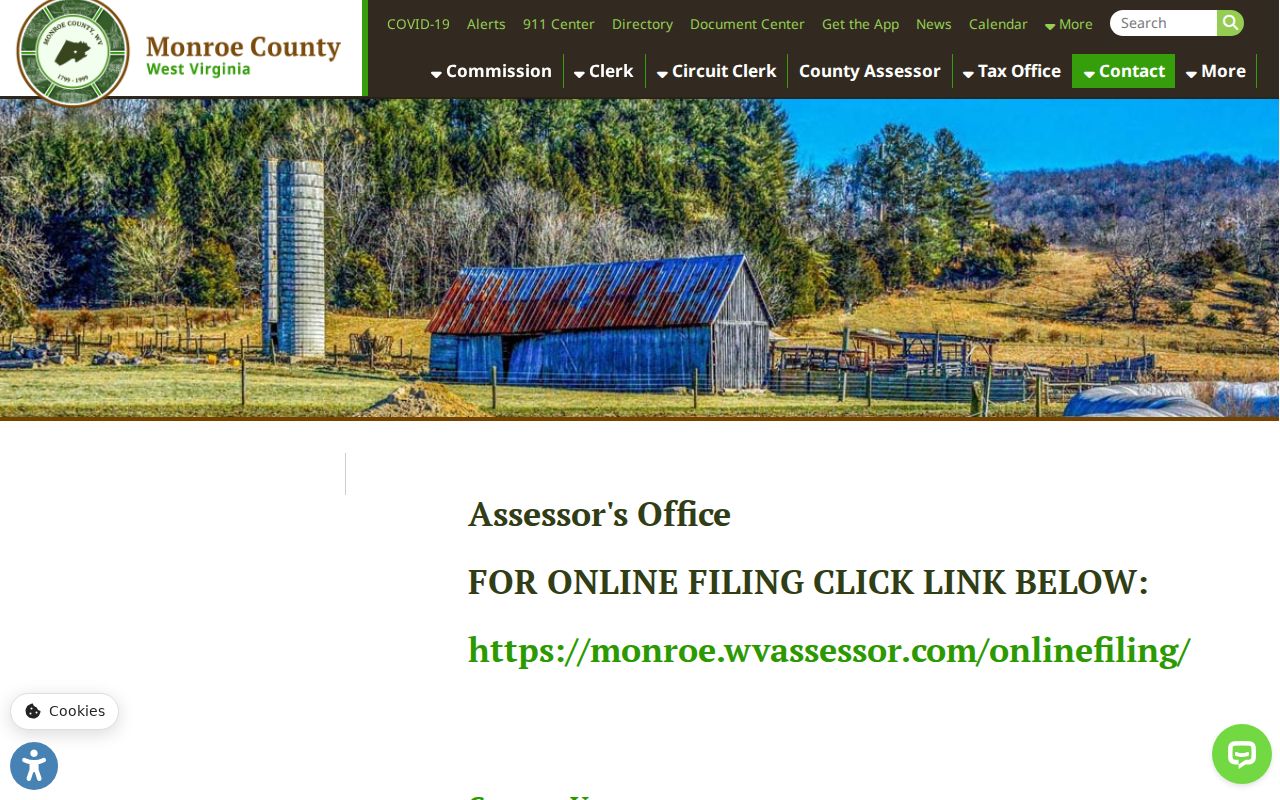
The office contact serves as the fallback for parcel-card questions.